
Squat Form Check: 4 Things to Look for on Video, and How to Fix Them
\nThe squat is a lift where you can feel sure your form is fine, then film it from the side and find you're shallower or leaning further than you thought. This guide covers the four things to check on video, with the thresholds RepScope actually uses to score your sets.
For filming, see how to film your lifting form. For squats, film from the side, with your whole body from head to toe in frame.
1. Depth: does your hip reach your knee?
The most common problem is simply not going deep enough. As the weight goes up, depth tends to shrink without you noticing.
What to look at: pause at the very bottom and compare the height of your hip crease with your knee. If your hip is level with or below your knee, you've reached parallel (thighs parallel to the floor).
RepScope's rule: parallel when the hip is level with or below the knee at the bottom. A tiny margin is allowed so that measurement noise doesn't flip the result.
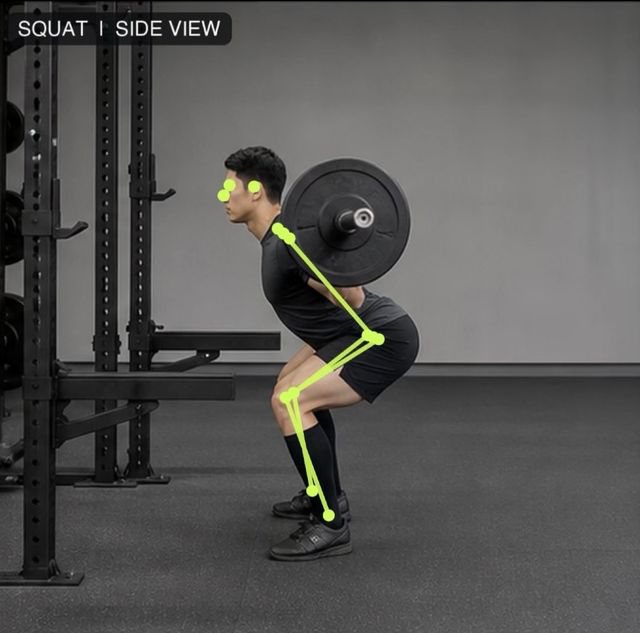
Depth is not judged by knee angle. Depending on your leg proportions and stance width, the same depth can mean a different knee angle from person to person. The "knee angle at the bottom" shown in RepScope is for reference only.
Squats above parallel still train your legs. But if your depth changes from rep to rep, you can't compare progress fairly. In powerlifting competition, the hip has to drop below the knee for a squat to count.
How to fix it: take 10-20% off the bar and squat until your thighs are parallel to the floor. If you can't feel where parallel is, try this drill:
2. Forward lean: are you folding over at the bottom?
Some forward lean in the squat is normal. The problem is leaning too far: it puts more load on your lower back and lets the bar drift forward.
What to look at: at the bottom, how far your back is tilted from vertical.
RepScope's rule: a torso more than 55° from vertical at the bottom is flagged as too much lean. In the front squat the bar sits in front of you, so you have to stay more upright to hold it - the limit there is 45°.
If you squat low-bar (bar lower on your back) or have long thighs, you'll lean more even with good form. If the lean is a deliberate part of how you squat, don't worry too much about the flag.
How to fix it: keep your chest up and your eyes fixed slightly ahead as you descend.
3. Out of the hole: bouncing, or hips rising first?
There are two common ways the turnaround at the bottom breaks down.
Dropping fast and bouncing
You drop to the bottom and spring back up off the rebound. That skips the hardest part of the lift, so your legs do less of the work, and your knees and back take more stress.
RepScope's rule: reaching the bottom within 0.8 seconds and spending 0.25 seconds or less near the bottom (within the lowest 10% of your range of motion) counts as a bounce.
How to fix it: take 2 seconds on the way down, pause for 1 second at the bottom, then stand.
Torso pitching forward on the way up ("good morning" squat)
Your hips rise first out of the bottom while your torso tips forward. Your legs push less and your lower back takes over. It tends to show up in the last, tired reps of a set.
RepScope's rule: if your torso tips 12° or more further forward on the way up than it was at the bottom, it's flagged. At 20° or more, it becomes the top-priority fix.
How to fix it: on the way up, think only "chest up first."
4. Tempo: is each rep too fast?
Moving fast isn't bad in itself. But a very fast descent tends to rely on a bounce, and it's a sign you're not fully controlling the weight.
RepScope's rule: a rep (down and back up) faster than 1.2 seconds may be using momentum.
How to fix it: aim for about 2 seconds down and 1 second up.
What the front view shows: knee cave-in and left-right differences
Everything above is checked from the side. Knees moving inward past your toes (knee valgus) can't be seen from the side - film one set head-on if you're concerned.
RepScope's rules (filmed from the front):
- At the bottom, a knee moving inward from the ankle by 15% or more of your stance width is flagged as caving in
- A difference of 10% or more of your stance width between left and right is flagged as asymmetry
Forward lean and bar path can't be measured from the front, so use both views.
Summary of the rules
| What | RepScope's rule | Common fix |
|---|---|---|
| Depth | Hip level with or below the knee at the bottom | Take 10-20% off / box squat |
| Forward lean | 55° or less at the bottom (45° for front squat) | Chest up / goblet squat |
| Bounce | Flagged if you drop within 0.8 s and turn around within 0.25 s | Pause 1 s at the bottom / pause squat |
| Torso pitching forward | Flagged at 12° or more of extra lean on the way up | Chest up first / tempo squat |
| Tempo | 1.2 s or more per rep | 2 s down, 1 s up |
| Knee cave-in (front) | Under 15% of stance width | Film from the front to check |
Summary
When you watch your squat, first pause at the bottom and check depth and lean, then look at how you come out of the hole. Fix one thing at a time: if you're shallow, drop the weight and own the depth first; if you bounce, start with pauses.
Film from the same spot every time and you can compare how your depth and lean change. With RepScope, just put your phone to your side and film - it checks every rep against these rules and narrows it down to the one thing most worth fixing.
\n
Film that set with RepScope
Put your iPhone to your side and film one set. RepScope detects your skeleton, scores the set out of 100 and narrows it down to one thing to fix. Everything runs on your iPhone. Free, no account needed.
Download free on the App StoreDeveloper of RepScope, an iPhone gym log with AI form checks. The thresholds in this guide are the actual values the app uses to score your sets.
This guide is general training information, not medical advice. If you feel pain or numbness, stop and consult a doctor or physical therapist.